How a Spline Joint Resists Miter Corner Separation
A spline joint reinforces a mitered corner by inserting a thin blade of material across the glue line, converting pee...
Read it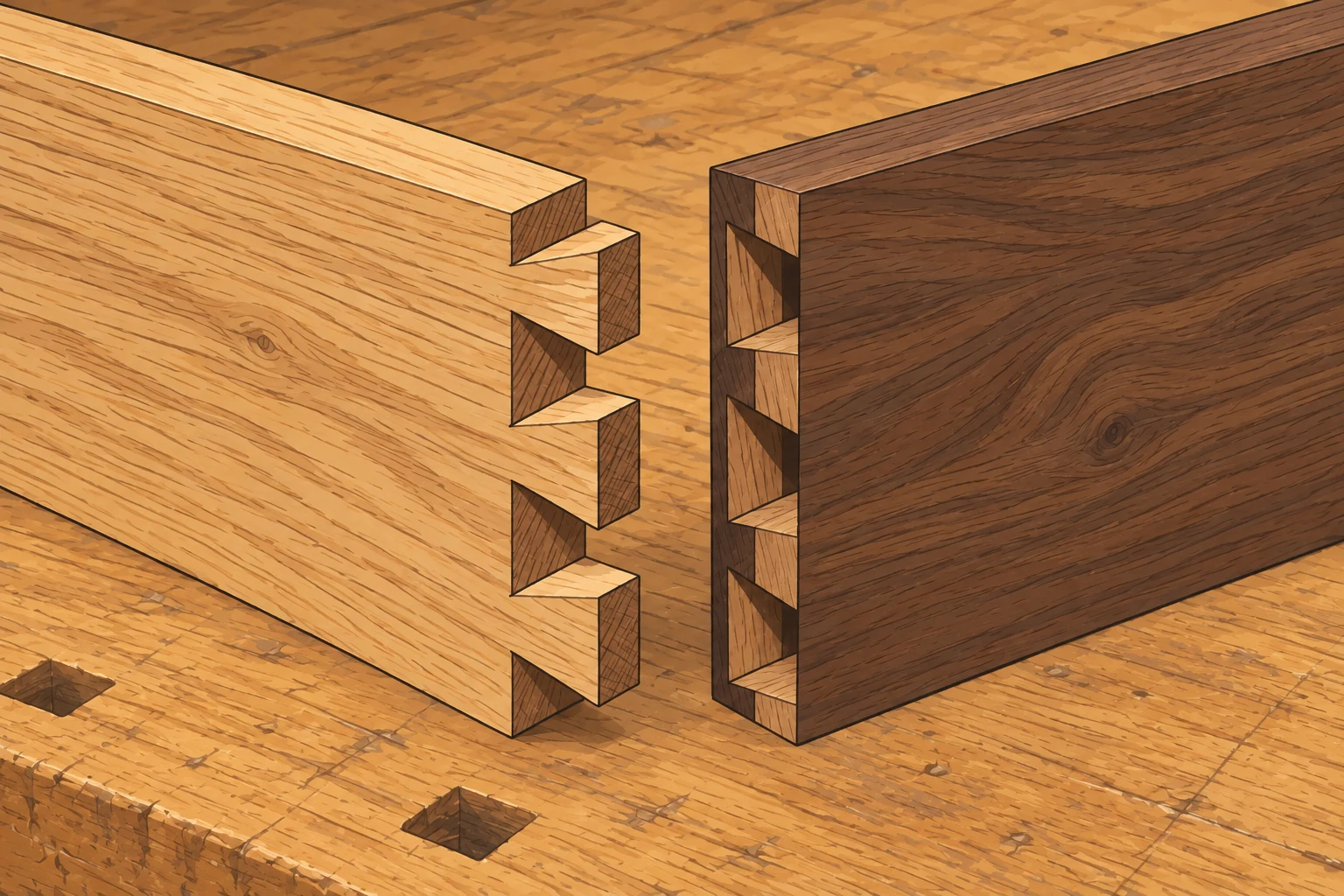
All Joinery & Construction articles from Furniture Made Clear.
A spline joint reinforces a mitered corner by inserting a thin blade of material across the glue line, converting pee...
Read itThe projecting section of a mortise-and-tenon joint is called the tenon — a shaped tongue of wood that locks into a c...
Read itA finger joint interlocks rectangular wood tabs across a corner, distributing glue surface area and resisting both te...
Read itA rabbet joint at the drawer box corner mechanically opposes the racking forces that open and close cycles impose on ...
Read itA biscuit joint uses a compressed wood wafer and adhesive to resist lateral racking force in furniture panels and fra...
Read itA dowel joint resists racking force through cylindrical wooden pins set in aligned blind holes — here is how the geom...
Read itA pocket screw anchors a face frame joint by driving at an angle through a pre-drilled channel, clamping two workpiec...
Read itThe mortise is a precisely cut cavity in wood that receives a tenon, transferring racking and shear forces through me...
Read itA bridle joint transfers load through mechanical interlock and long-grain glue surface, distributing shear and rackin...
Read itWood joint types differ by the direction of force they resist. Mortise-and-tenon, dovetail, dowel, and biscuit joints...
Read itThe mechanics behind cam-lock fasteners — how a rotating cam pulls a dowel pin to draw flat-pack panels tightly together.
Read articleThe mechanics of a mortise-and-tenon joint — how a projecting tenon fits into a cut cavity to resist both bending and twisting.
Read articleThe geometry behind a dovetail joint — how angled, interlocking pins mechanically resist being pulled apart.
Read article